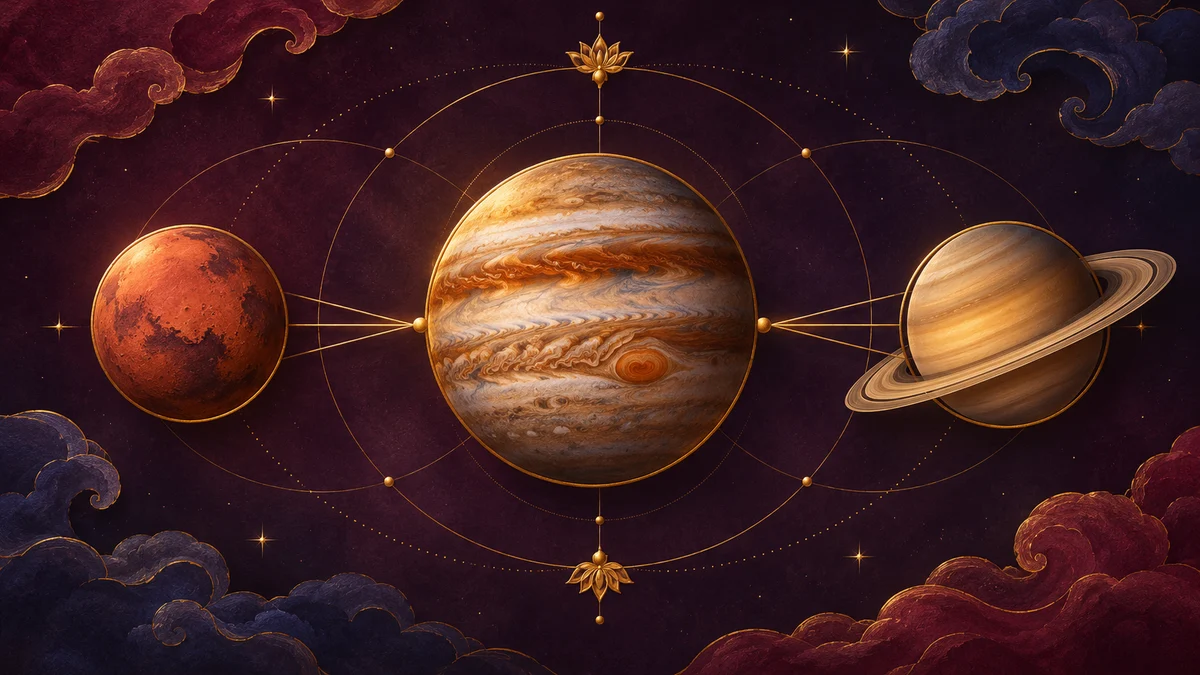
Vedic astrology is a system for understanding how planets affect different areas of life. An important concept in Vedic astrology is planetary aspects, called Drishti. Drishti means “sight” or “vision.” It refers to the influence of a planet on another house or planet from its position in the birth chart. Astrologers use these aspects to understand personality, relationships, career, finances, health, and other life events.
Understanding planetary aspects makes a birth chart easier to read because planets don’t act alone. Their positions, strengths, conjunctions, and aspects create different possibilities.
What Are Planetary Aspects in Vedic Astrology?
In Vedic astrology, a planetary aspect happens when a planet influences another house or planet from its position in the horoscope. Each planet aspects the seventh house from where it is placed. Some planets also have special aspects that make their effects different.
The main planetary aspects are:
-
Sun: Has a seventh-house aspect.
-
Moon: Has a seventh-house aspect.
-
Mars: Has seventh, fourth, and eighth-house aspects.
-
Mercury: Has a seventh-house aspect.
-
Jupiter: Has seventh, fifth, and ninth-house aspects.
-
Venus: Has a seventh-house aspect.
-
Saturn: Has seventh, third, and tenth-house aspects.
-
Rahu and Ketu: Their aspects are understood differently across Vedic astrology traditions.
The nature of an aspect depends on the planet, its strength, the house it affects, and the whole birth chart.
How the Positions of the Planets Influence Different Areas of Life
Planetary aspects in Vedic astrology are often studied to see how planets interact with different areas of a person’s life. For example, an aspect on the tenth house may relate to work and career duties. An aspect on the seventh house may relate to relationships and marriage.
A helpful planetary influence may support the matters linked to a house. A challenging influence may show where more patience, discipline, or care is needed.
An interpretation rarely depends on one factor alone. Astrologers usually study the whole horoscope before making a judgment.
Special Features of Mars, Jupiter and Saturn
Mars, Jupiter, and Saturn are important in Vedic astrology because they have special aspects.
Mars aspects the 4th, 7th, and 8th houses from its position. Mars is linked to energy, courage, action, competition, and aggression. Its aspect may increase activity and intensity in the house it affects.
Jupiter aspects the 5th, 7th, and 9th houses. Wisdom, learning, growth, guidance, and hope are linked to Jupiter. Its aspects are often studied in relation to education, relationships, creativity, beliefs, and personal growth.
Saturn aspects the 3rd, 7th, and 10th houses. Saturn stands for discipline, duty, structure, patience, and long-term effort. Its aspects may highlight duties, hard work, delays, or lessons linked to the houses it affects.
These readings should be understood with the full horoscope, not alone.
Career and Planetary Aspects
The tenth house is linked to career, reputation, duties, and public life. So, planets that aspect the tenth house may be important when studying career matters.
For example, Saturn’s aspect on the 10th house is linked to discipline, hard work, and duty. Mars may bring ambition, competition, or a desire to lead. Jupiter’s influence may relate to wisdom, guidance, teaching, or career growth.
Other factors are also important, such as:
-
Condition and position of the tenth lord
-
Planets in the 10th house
-
Strength of the Ascendant and its lord
-
Planetary periods or Dasha
-
Position of the Sun and Saturn
-
Related divisional charts
So, one planetary aspect does not define a person’s career or success.
Planetary Aspects and Connections
In Vedic astrology, planetary aspects are also important for relationships. The seventh house is linked to marriage, partnerships, and close personal ties.
The seventh house aspect is studied along with the seventh lord, Venus, Jupiter, and other factors. For example, Jupiter’s aspect is linked to guidance, understanding, and support. Saturn’s influence may relate to duty, commitment, patience, or a slower approach to relationships.
Mars is often linked to strong energy and aggression. Astrologers study the rest of the chart to see whether this energy is expressed in a positive way or creates more intensity.
Planetary Aspects and Money
The second and eleventh houses are often studied when looking at wealth, income, savings, and financial resources. Planetary aspects on these houses can add more detail to the reading.
Jupiter is linked to growth and abundance. Saturn may suggest saving, discipline, delayed results, or long-term financial planning. Venus relates to comfort, material pleasures, and resources. Mercury is linked to calculation, trade, communication, and business.
But you can’t judge financial results from one aspect alone. You also need to study the second and eleventh lords, their positions, the tenth house, planetary periods, and other factors in the chart.
Aspects Between Planets and Personal Growth
Planetary aspects may reflect personal growth as well as material matters. Different planetary energies may show different qualities and life lessons.
-
Sun: Confidence, identity, authority, and self-expression
-
Moon: Emotions, habits, sensitivity, and mental responses
-
Mars: Courage, action, motivation, and assertiveness
-
Mercury: Communication, reasoning, learning, and adaptability
-
Jupiter: Knowledge, wisdom, optimism, and guidance
-
Venus: Relationships, beauty, creativity, and enjoyment
-
Saturn: Discipline, patience, responsibility, and perseverance
When these planets are placed in certain houses, astrologers may see them as areas for growth or challenges to overcome.
The Significance of the Complete Birth Chart
It is important not to study planetary aspects in Vedic astrology alone. A planet may have an aspect, but its strength, sign, house, conjunctions, retrograde state, and links with other planets can change its meaning.
Astrologers may look at the following for a more detailed reading:
-
Ascendant and Ascendant ruler
-
House lords and their positions
-
Planetary strengths
-
Conjunctions
-
Positive and negative influences
-
Nakshatras
-
Vimshottari Dasha and other planetary periods
-
Divisional charts
-
Transits
This approach gives more insight than looking at just one factor.
Frequently Asked Questions (FAQs)
What are planetary aspects in Vedic astrology?
Planetary aspects, or Drishti, describe how a planet influences another house or planet in a birth chart. Astrologers study these aspects to understand different areas of life.
Which planets have special aspects in Vedic astrology?
Mars, Jupiter, and Saturn have special aspects. Mars aspects the 4th, 7th, and 8th houses. Jupiter aspects the 5th, 7th, and 9th houses. Saturn aspects the 3rd, 7th, and 10th houses.
What is the 7th aspect in Vedic astrology?
The 7th aspect refers to a planet’s influence on the seventh house from its position. In the common Parashari system, all seven classical planets have a seventh-house aspect.
How do planetary aspects affect career?
Astrologers study planetary aspects on the 10th house to understand career matters. They also look at the 10th house lord, planetary strengths, Dashas, and other birth chart details.
Can planetary aspects influence marriage and relationships?
In Vedic astrology, aspects on the 7th house are studied for marriage and partnerships. Their meaning depends on the planets involved and the full birth chart.
Summary
In Vedic astrology, planetary aspects help explain how planets affect different areas of a birth chart. According to traditional beliefs, planets influence houses and other planetary energies through their direct and special aspects. This adds depth to horoscope reading.
Whether the topic is career, relationships, money, personality, or personal growth, aspects are best understood as part of a wider astrology system. A full analysis considers the birth chart, planetary strengths, house lords, Dashas, and other factors. It does not depend on one planetary aspect alone.
For a deeper understanding of your birth chart, you can contact Astro Niyati for a personal Vedic astrology consultation.
Explore this in your own chart
Use our free Kundali tools to explore the basics. For the next step, read our Zodiac Sign Lords and Their Importance in Vedic Astrology or ask about consultation availability.
Traditional reference
Brihat Parashara Hora Shastra — English reference edition, for the traditional framework of planets, signs, houses, aspects and planetary periods. Interpretations vary between traditions.